Gold King Contractor to Face Navajo Nation Claims

Environmental Restoration LLC, which contracted with the EPA to work at the Colorado mine and is allegedly partly responsible for the disaster that polluted two rivers that flowed into the Navajo Nation and New Mexico, had asked U.S. District Judge M. Christina Armijo to toss the lawsuits, but the judge found there was enough evidence to proceed with most of the plaintiffs’ claims.

The judge first declined to toss the state and Navajo Nation’s Comprehensive Environmental Response, Compensation and Liability Act claims for cost recovery and injunctive relief. In particular, she rejected Environmental Restoration’s assertion that is was not a facility “operator” as defined by CERCLA.

She noted that the company was one of the parties present and working at the site on Aug. 4 and Aug. 5, 2015.

Read more in Law360  By Juan Carlos Rodriguez

The Navajo Nation is represented by John Hueston, Moez Kaba, Andrew Walsh, and Kasey Mitchell.

 

DOJ Memo Signals Qui Tam Sea Change

Memo suggests shift in DOJ’s qui tam approach

By Brian Hennigan and Padraic Foran

The Department of Justice issued an internal memorandum this month that signals a shift in its approach to qui tam actions, encouraging government attorneys to act more aggressively to dismiss certain False Claims Act cases. Whether this policy will actually result in more dismissals remains to be seen. But the policy is a welcome one, especially for defendants. It also has immediate and significant implications for all qui tam litigants, especially those in the pre-intervention stage.

In every qui tam action filed under the False Claims Act, 31 U.S. Section 3739, the government is authorized to investigate and decide whether to intervene — that is, take over the litigation. About 75 percent of the time, the government declines to do so. But the scant 25 percent of cases in which it does intervene account for the overwhelming majority of recoveries. In 2017, more than 87% of total qui tam recoveries (3,011,269,763) came from intervention cases. Non-intervention cases accounted for less than 13 percent of recoveries (or $425,767,335). In 2016, non-intervenors fared even worse, accounting for just 4 percent of total recoveries.

Despite the low success rate of non-intervention cases, the government seldom seeks their dismissal. Yet dismissal, according to the memo, is necessary if the DOJ is to perform its “important gateway keeper role in protecting the False Claims Act.” And until this month, there have not been formal guidelines for seeking dismissals.

Click here to read more.

Securities Cases to Watch at the High Court

These include the statutory interpretation of the Dodd-Frank Act and its whistle blower protections, the jurisdictional reach of state courts in certain class actions, and separation of powers issues related to the appointments clause of the U.S. Constitution. Ms. Williams also discusses a fourth securities case that was accepted for review, but which has been stayed pending settlement. Nonetheless, it presents an important question the court is likely to review in the future.

From the article:

Lucia v. Securities and Exchange Commission (on appeal from the D.C. Circuit).

The short-term impact of this case for litigants will depend on how the court crafts a remedy if it finds a constitutional violation. If the court holds that the SEC judges have been “inferior Officers” all along, and have, for decades, been unconstitutionally presiding over proceedings, what happens next? Will all past and present administrative actions heard by SEC judges be dismissed and expunged because of the unconstitutionally appointed judge who presided over the case? That is unlikely. But if the court finds that the SEC’s practice violates the appointments clause, the appropriate remedy is not easy to determine.”

After Wildfires and Mudslides, SoCal Edison Engages Hueston Hennigan

Hueston Hennigan is recognized as one of the top trial boutiques in the country. The firm is noted for its commitment to taking matters of public and social import, and the work of its attorneys has been recognized by U.S. News and World Report/Best Lawyers, Benchmark Litigation, The Los Angeles Daily Journal, Chambers and Partners USA, and other legal directories and news outlets.

The Art of the Trial: Closing Arguments

The trial is over. All witnesses have finished their testimony. The exhibits have either been received into evidence or never will be admitted. The trial court has reviewed with counsel the jury instructions. The jury is assembled in the box. The trial judge turns to you, telling the jury that it will first hear from plaintiff’s counsel, in closing argument. You stand, turn to the jury, and…

Clearly, this is not the time to start thinking about the form and substance of your closing argument. You have doubtlessly studied the subject before the day in court. You have researched the subject, and probably run though the argument with friends. Perhaps you have rehearsed it on the long commute to the courthouse during the trial. Depending on the size of the case and the anxiety level of your client, you have likely presented the closing argument to mock juries to gauge their response to your key points.

I have tried approximately 50 cases in federal and state court, as a federal prosecutor, a criminal defense counsel. I have tried criminal and civil cases on both the plaintiff and defense side. There is no “one size fits all” formula for effective closing arguments. But, there are a number of practice tips than attorney should keep in mind in designing and presenting an effective closing argument.

Read more in: The Daily Journal

Michael Behrens and Xinlin Li Morrow Promoted to Counsel

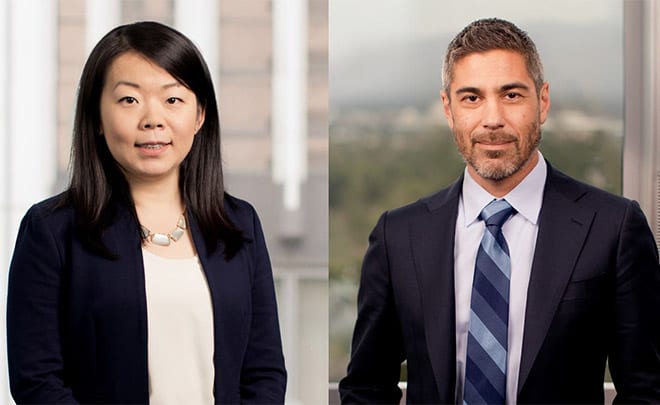
Ms. Morrow’s practice focuses on white collar defense, complex business litigation, and patent litigation. She has represented clients in a broad range of industries, including aviation, biotechnology, cyber security, finance, professional sports, software, and telecommunications. She also has successfully represented individuals facing SEC and DOJ investigations and actions.

“Xinlin is a dynamic lawyer who handles cases across subject matters,” said Moez Kaba. “She has shown that one can crush a deposition in Hong Kong one morning, and be back for another one in Los Angeles the next day, without skipping a beat.  Xinlin has also developed a critical IP expertise while expanding her contributions in many other areas.”

Mr. Behrens has litigated contract, defamation, commercial lease, health care fraud, RICO, labor union, and C-suite employment disputes, and has argued and won before the Ninth Circuit and in district court.  Mr. Behrens specializes in representing governments and universities, and advises and guides institutions facing regulatory action.

“Mike sets himself apart as a strategic, measured, and earnest advocate for his clients,” said John Hueston.  “His steady approach to matters and clients make him both a pleasure to work with and an essential part of our teams.  More than once, Mike has been called upon to parachute into a case to support a trial or help win summary judgment.  He has done so with ease and skill.”

With the promotions of Ms. Morrow and Mr. Behrens, the firm continues its annual promotion to counsel of associates who are poised for partner consideration in the coming years. “We believe we have some of the best associates in the nation, and Xinlin and Mike are great examples of that,” said Managing Partner Brian Hennigan.


Michael Behrens and Xinlin Li Morrow Promoted to Counsel


Navajo Nation Sues Wells Fargo

Among the populations targeted by Wells Fargo were the tribe’s elders — some of whom do not speak English well. They were purposely confused and deceived into purchasing products to help employees meet banking quotas. Wells Fargo went so far as to attend community events, like flea markets and basketball games, in an attempt to sign Navajo people up for unnecessary accounts en masse—all to meet its sales targets. These practices were particularly harmful because Wells Fargo, in some cases, is the only banking option for residents.

“Wells Fargo’s targeted exploitation of the most vulnerable Navajo communities reflects an even darker and more insidious side to Wells Fargo profiteering schemes that have been unearthed to date.  Wells Fargo deceived the Navajo people and lied to their government, subverting the government’s ability to represent the legitimate interests of the Tribe,” said attorney John Hueston.

“Wells Fargo’s exploitation of its customers has been well documented,” said President Russell Begaye. “But even so, Wells Fargo’s actions toward the Navajo people have been of a uniquely outrageous nature.”

Attorney General Ethel Branch said, “Wells Fargo must be held accountable for its unfair and unlawful practices directed toward the Navajo people. Among their other despicable acts, the bank specifically targeted our most vulnerable population – our elders.”

The suit was filed in the United States District Court for the District of New Mexico.

The Hueston Hennigan team includes John C. Hueston and Moez M. Kaba.


Moez Kaba Talks Diversity with Benchmark Litigation

Benchmark Q & A with Moez Kaba

Moez Kaba is the youngest partner at one of the country’s premier trial boutiques, Hueston Hennigan, a Los Angeles-based shop formed by a group of former Irell & Manella commercial litigation partners. The firm has earned considerable traction in the legal community via some high-stakes and high-profile appointments. Kaba, a co-founder of the firm, reflects both the firm’s approach as well as the cultural and generational shift in the US litigation landscape. In this Q&A with Benchmark’s Michael Rafalowich, he discusses these issues at length. (more…)

Hueston Hennigan Reports Interference with State Audit

Her approval of a plan in which top aides would preview campus administrators’ confidential survey responses “reflected poor judgment and set in motion a course of conduct that the Board of Regents finds unacceptable,” board chairman George Kieffer said in a statement after the regents met behind closed doors for nearly five hours.

But the regents quickly and unanimously agreed to support Napolitano’s continued leadership, Kieffer said after the meeting.

The regents asked Napolitano to acknowledge responsibility and apologize, which she did in her own statement right after Kieffer read his. Later, she reiterated that she “exhibited poor judgment in approving an ill-advised approach” to the state audit and “deeply regret this mistake.”

The regents, meeting in San Francisco, were responding to an independent investigation that found Napolitano’s top aides had sought to suppress campus criticism of the central office in confidential surveys from State Auditor Elaine Howle.

Napolitano approved a plan to review the surveys about her office’s operations and services before they were sent back to the auditor.

After Howle publicly alleged that Napolitano’s office improperly interfered, the regents commissioned the investigation by former state Supreme Court Justice Carlos Moreno and the Hueston Hennigan law firm. The investigation found that Napolitano’s chief of staff, Seth Grossman, and deputy chief of staff, Bernie Jones, had pre-screened campus responses “with the specific purpose of shaping the responses to be less critical of” the UC Office of the President.

In a conference call with campus administrators, the aides said the surveys were “not the time and place to air dirty laundry,” and they also tried to hide their interference from the auditor, the investigation determined.

Click here to read more.